
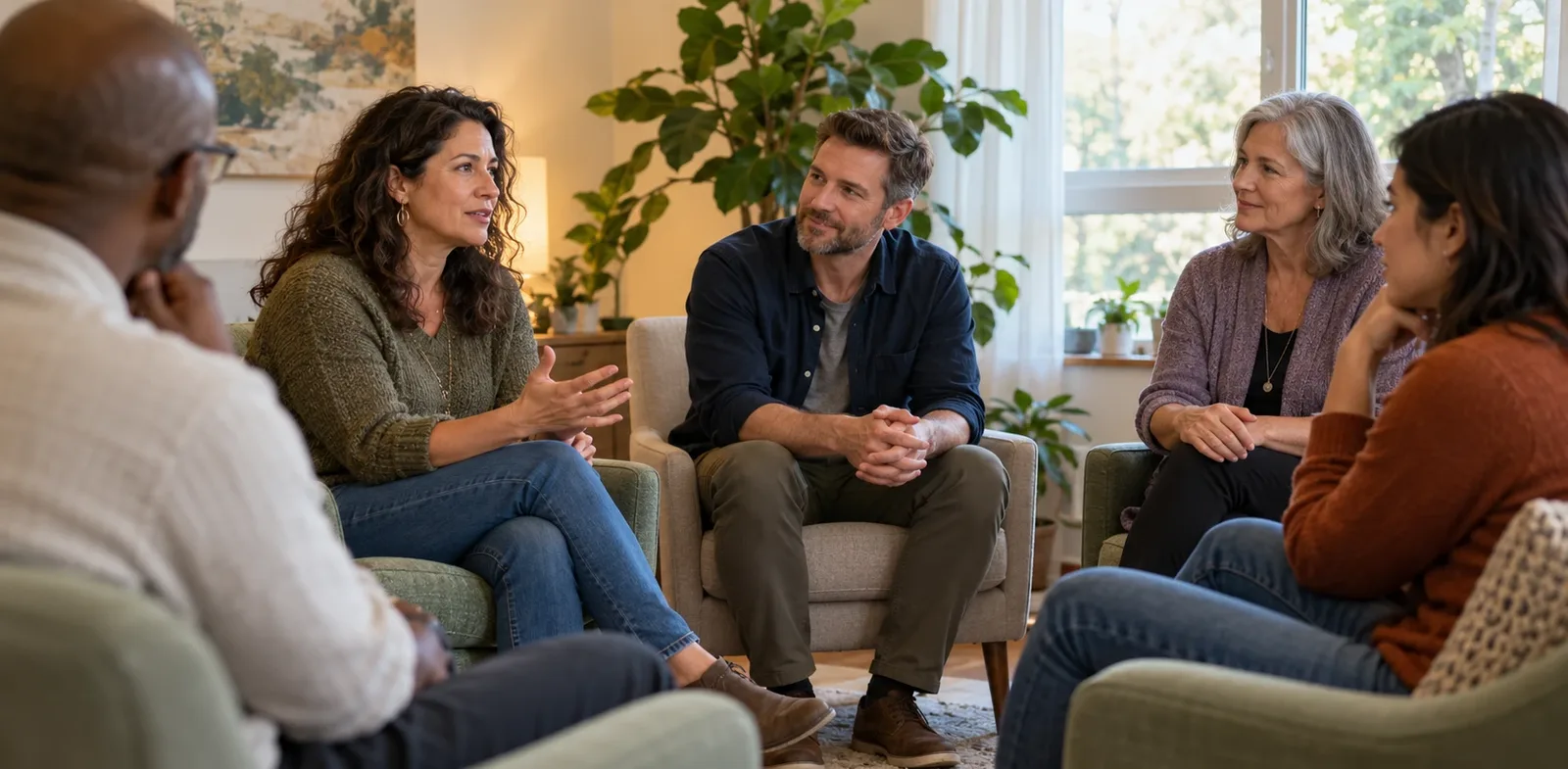
Staying in touch with people throughout the day and feeling understood by them are two different experiences. A lot of our contact now happens through screens, and those connections can be meaningful. Many people still carry what they are going through largely on their own.
A therapy group offers the experience of being understood in person, by people who are working on something of their own.
Discovering What You Share
Someone across the room describes an experience close to one you have carried privately for years, and what felt particular to you becomes something other people recognize. Psychiatrist Irvin Yalom, whose work has helped shape modern group psychotherapy, called this universality and counted it among the core ways groups help people.
Hearing it from a peer can land differently than hearing it from a therapist. Over the weeks, those moments of recognition build into relationships. Members begin to notice when someone is having a harder week and remember what was said last time. That sense of belonging develops gradually, and it becomes a source of support outside individual sessions.
You Set the Pace
Joining a group can feel intimidating, especially when what you are working on is personal. In the groups I currently run, members are never pressured to disclose or to confront another member, and “I pass” is always a complete answer. Many people spend the first few sessions mostly listening, and that is a natural way to settle in.
Differences of opinion and strong feelings may still arise, as they do anywhere people are being honest with each other. I help the group work through those moments respectfully.
You Get to Practice in Real Time
In individual therapy, you and I can talk about how conflict goes for you, where your boundaries tend to give way, and what happens when you try to say something difficult. A group gives you the chance to experience those situations with other people present under the watchful eyes of an experienced mental health professional:
- Saying what you think when someone disagrees with you
- Setting a boundary and staying with how that feels afterward
- Noticing yourself start to shut down, and naming it as it happens
- Asking for something and letting yourself receive it
- Staying present when the room becomes emotionally close
You can try responding differently, notice what happens, and talk about the experience with support from me and from other members.
You Learn From Watching Others
Someone describes how they handled a conversation with their mother, and it gives you an idea you would not have reached alone. Someone names a feeling you have had for years and never had a word for. Over the months, you also see people work through things that looked fixed when they first described them.
Being useful to someone else is part of the work too. Many people find that offering support to another member changes how they see their own situation.
Groups Alongside Individual Therapy
Group therapy can be an effective form of treatment on its own. The groups I run, however, are designed for those adults who have had trauma as children, to complement individual therapy, and members take part in ongoing individual therapy at the same time.
For clients also participating in individual trauma therapy, group sessions may provide opportunities to practice coping skills, build supportive relationships, and apply what they are learning in their individual sessions through group engagement.
Sharing a facilitator also keeps the cost of each group session lower than an individual session, which makes a group a practical way to add a second weekly source of support.
I completed certificates in both individual and group modalities during my clinical psychotherapy residency, and group work has been part of my practice since.
The Groups Beginning in December
Two groups begin in December 2026. Restoring Resonance and Resilience is for adults healing from childhood neglect, misattunement, or related attachment wounds. The Childhood Sexual Abuse Recovery Group is for adult women healing from childhood sexual abuse.
Both groups run for 16 weeks, with one 90-minute session each week, in person at my Suffern, NY office. Each is limited to eight members. The package also includes two 60-minute individual sessions with me: a screening interview before the group begins and a check-in at the midpoint. These are separate from the ongoing individual therapy each member continues alongside the group.
Joining begins with that screening interview, so we can both consider whether a particular group fits what you are working on. You can read more about each group on my groups page, or call me at 845-202-9774 to talk it through.
This post is general information and is not clinical advice or a substitute for individual assessment and treatment. Reading it does not create a therapist-client relationship. If you are in immediate danger or thinking about harming yourself, call or text 988, call 911, or go to your nearest emergency room.